
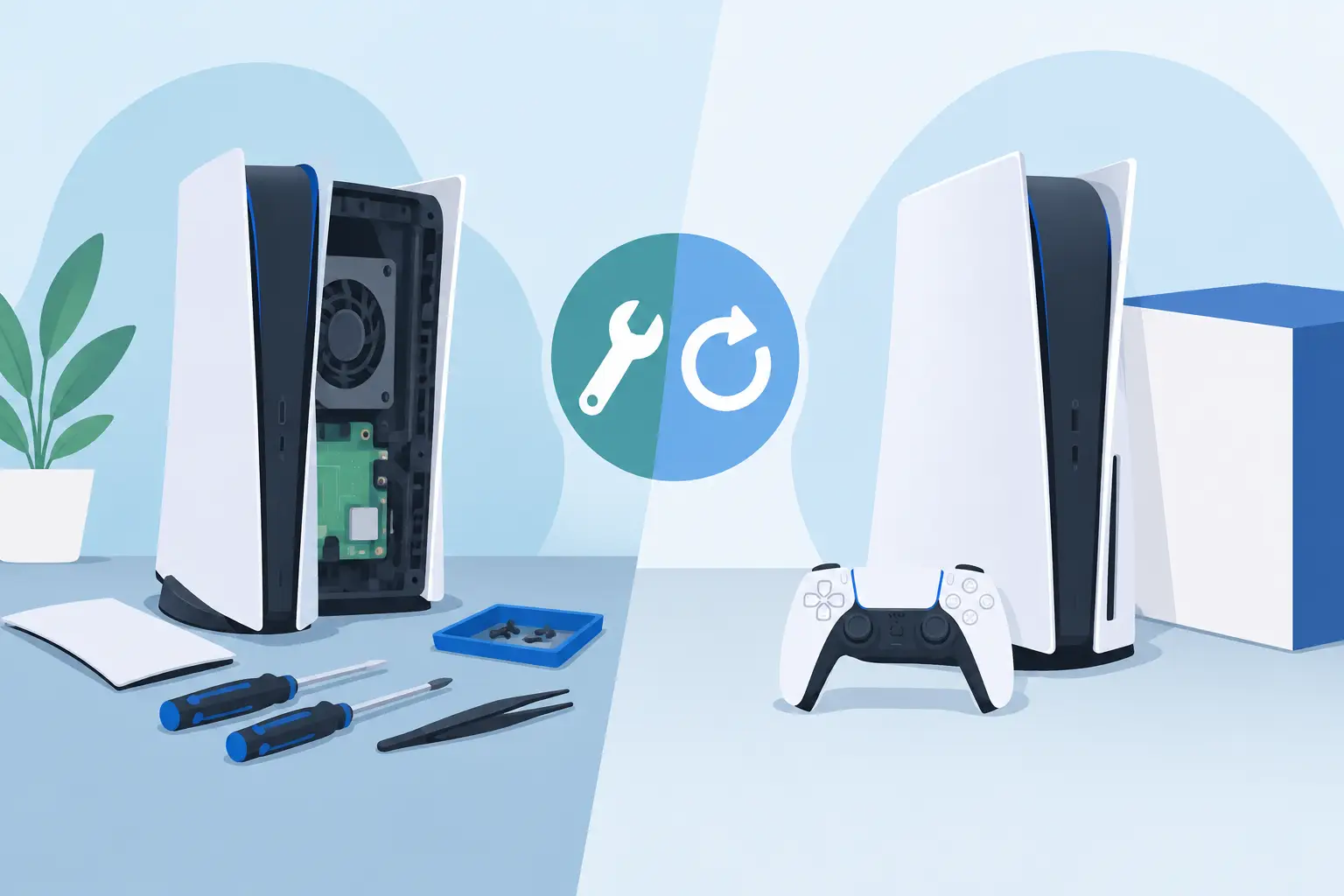
Your console fails just as a new release lands, the children want to play, or you are halfway through a game you have spent months completing. At that point, console repair versus replacement is not just a question of price. It is about downtime, saved games, accessories, availability and whether the fault is genuinely serious enough to justify buying again.
For many common faults, a professional repair is the quicker and more cost-effective route. A damaged HDMI port, worn charging port, faulty disc drive or overheating issue can make a console feel beyond saving, even when the underlying repair is straightforward for an experienced technician. The right answer depends on the console’s age, condition and fault, not simply whether it turns on.
Console Repair Versus Replacement: Start With the Fault
The type of fault matters more than the symptom. A PlayStation or Xbox that shows no picture may have a damaged HDMI port, but it could also be a cable, television input or internal board fault. A Nintendo Switch that will not charge may need a charging port repair, a battery replacement or further diagnosis. Replacing the whole console before finding the cause can mean spending far more than necessary.
Physical faults are often good candidates for repair. This includes cracked screens on handheld consoles, damaged USB-C ports, broken HDMI ports, noisy or failed cooling fans, stick drift and worn controller buttons. These parts receive regular use and can fail without the main console itself being at the end of its life.
Problems caused by heat can also be repairable. If the fan is constantly loud, the console shuts down during play or performance drops after a short time, it may need internal cleaning, cooling work or a component-level repair. Leaving it to worsen can turn a manageable issue into a more expensive fault, so it is sensible to stop using a console that is overheating heavily.
A no-power fault needs more care. It may be related to the power supply, charging system, internal connection or main board. This is where a proper diagnosis is valuable. Do not assume that no power automatically means replacement, but avoid repeatedly plugging in a console that smells burnt, becomes unusually hot or has been exposed to liquid.
When Repair Is Usually the Better Value
Repair is normally worth considering when the console is otherwise reliable, the issue is isolated and a replacement would cost considerably more. This is especially true for current-generation systems, OLED handhelds and special editions, where buying like-for-like can be expensive or difficult.
It can also make sense for an older console that you still use regularly. A PlayStation 4, Xbox One or Nintendo Switch may not be the newest hardware, but it may still be the right console for your games, subscriptions and household setup. If the repair restores dependable use at a sensible cost, there is little value in replacing it simply because a newer model exists.
There is another cost people often miss: everything around the console. A replacement might require new cables, additional storage, another controller or a compatible dock. You may also need time to sign back into accounts, reinstall large game files and reconfigure parental controls. A repair keeps the setup you already know.
Saved data is a major consideration too. Cloud saves can help, but they are not always enabled, current or available for every game and account. If a console is still powering on intermittently, avoid factory resetting it before getting advice. A reset may remove useful diagnostic information and, in some circumstances, put locally stored data at risk.
At Mobitech Sheffield, a technician can assess the fault before you commit to a repair. Clear advice and transparent pricing give you a practical basis for deciding whether the job is worthwhile, rather than asking you to gamble on a replacement.
When Replacement May Be the Sensible Choice
Replacement can be the better decision when several expensive faults appear at once. For example, an ageing console with liquid damage, an unreliable power issue, a damaged motherboard and a failing disc drive may cost more to restore than it is worth. The same applies if the repair cost approaches the price of a tested replacement console with a meaningful guarantee.
Consider replacement if you were already planning an upgrade for reasons beyond the fault. A move from an older generation to a newer console may bring better game support, storage, loading times and features. In that case, paying for a major repair on old hardware may only delay a purchase you know you want to make.
Parts availability can affect the decision. Some older, rare or heavily damaged models need specialist parts that are no longer readily available. A trusted repairer should explain this plainly, rather than promise a repair that cannot be completed to a good standard.
Manufacturer cover matters as well. If the console is still within its manufacturer warranty or retailer protection period, check the terms before arranging an independent repair. Unauthorised work can affect that cover. Once the original cover has expired, a warranty-backed local repair often becomes a more attractive option.
Compare the Full Cost, Not Just the Ticket Price
A fair comparison starts with the repair quote and the true replacement cost. Do not compare a repair to the advertised price of the cheapest used console you can find. Compare it to a replacement in comparable condition, with the storage, controller, cables and reliability you need.
Ask what is included in the repair price. Quality replacement parts, experienced labour, diagnosis and a workmanship warranty all contribute to the value of the job. The lowest quote is not always the best value if it relies on poor-quality parts or leaves you with no support if the same issue returns.
Also consider how long you will keep the console. A modest repair on a console you expect to use for another two or three years can be excellent value. A costly repair on a device you plan to replace within months is harder to justify. There is no one percentage that makes the decision for everyone, but a professional assessment should leave you with a clear, pressure-free choice.
A Practical Way to Decide Before Booking
Start by checking the simple things. Test another known-working HDMI cable, power lead and wall socket where appropriate. Remove any disc, disconnect unnecessary accessories and check for visible damage to ports. For a controller problem, try pairing a second controller before assuming the console itself is faulty.
Then take note of the symptoms. Does the console show a light but no display? Does it charge only when the cable is held at an angle? Does it overheat after ten minutes, make clicking noises or fail only with discs? Specific details help a technician diagnose the issue faster and give a more accurate quote.
Avoid home repairs unless you have the correct tools and experience. Modern consoles contain delicate connectors, tightly packed components and, in some cases, power supply parts that should not be handled casually. A damaged HDMI connector or charging port can become a board repair if it is forced or incorrectly removed.
Finally, choose a repairer that explains the process. You should know what fault has been found, what the repair involves, what it will cost and what happens if the device cannot be fixed. A no-fix-no-fee approach removes much of the risk when the problem is not obvious from the outside.
Repair Can Be the Faster Route Back to Playing
Replacement is not always quicker. Finding the right model, arranging collection or delivery, transferring accounts and downloading games can take longer than an available same-day repair. For common faults, a local technician may be able to restore your console while you wait or within the day, subject to diagnosis and parts availability.
The best decision is the one that gets you a reliable console without wasting money. If the fault is contained and the device still suits your needs, repair can protect your budget and keep your gaming setup intact. If the diagnosis shows extensive damage or poor value, you can replace it knowing you made the choice with the facts in hand.
Before retiring a console, have the fault checked properly. A clear diagnosis may be all that stands between a frustrating breakdown and getting back to the game.
