
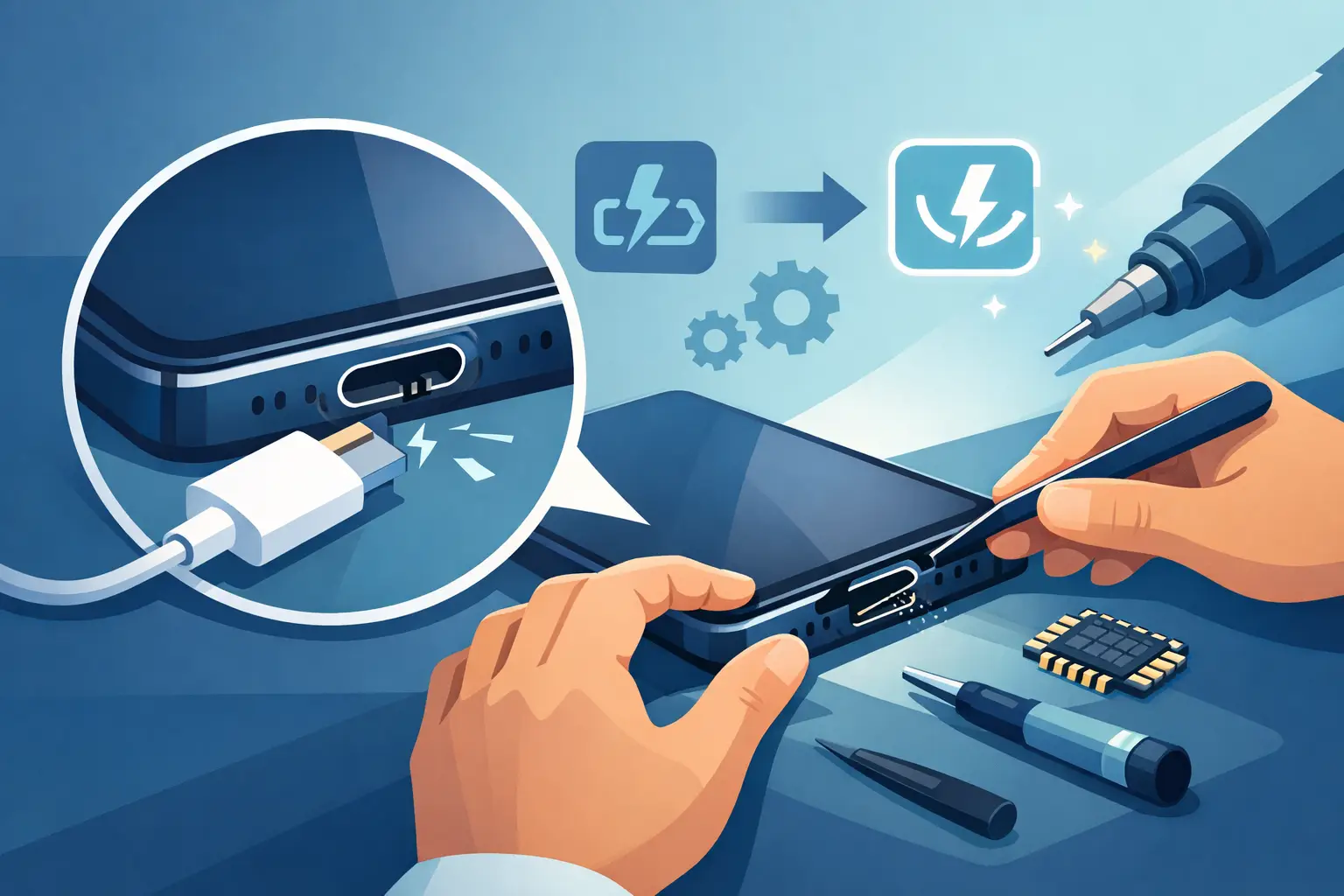
If your phone only charges when the cable is held at a strange angle, the question usually comes up fast: can a charging port be repaired? In many cases, yes. A faulty charging port is one of the most common hardware issues on phones, tablets, laptops and games consoles, and it is often repairable without replacing the whole device.
That said, the right fix depends on what has actually gone wrong. Sometimes the port is simply packed with lint or dust. Sometimes the connector pins are bent or damaged. In other cases, the issue is not the port at all, but the charging cable, battery, power management circuit or motherboard. A proper diagnosis matters, because guessing can waste time and money.
Can a charging port be repaired or does it need replacing?
The short answer is that a charging port can often be repaired, but not always in the same way. Minor issues may be fixed through cleaning, re-seating a loose connection or repairing solder points. More serious damage usually means replacing the charging port assembly.
On many smartphones, the charging port sits on a small daughterboard or flex assembly. If that part is damaged, a technician can replace the board rather than the full handset. On other devices, especially some premium phones, tablets and laptops, the port may be soldered directly to the main board. That makes the repair more delicate and more dependent on the condition of the surrounding components.
This is why two devices with the same charging symptom can need very different repairs. One might be a simple port replacement completed the same day. Another might need board-level work or reveal a wider fault.
Common signs your charging port is the problem
A charging port fault rarely starts with a complete failure out of nowhere. More often, the warning signs build up over time. Your device may charge intermittently, stop charging unless the lead is pushed in firmly, or disconnect with the slightest movement. You might also notice that data transfer no longer works through the same port.
Visible signs matter too. If the port looks loose, the centre tongue appears bent, or there is obvious debris inside, the port itself is a likely suspect. On USB-C devices, wear can make the cable feel less secure than it used to. On older Lightning or Micro-USB connections, physical strain often leads to cracked pins or broken solder joints.
Heat can also be a clue. If the device or charging cable becomes unusually warm during charging, stop using it until it has been checked. Overheating can point to internal damage, and continued use may make the repair more expensive.
What causes charging ports to fail?
Most charging ports fail because of repeated physical stress. Daily plugging and unplugging wears the connector over time. Pulling the cable out at an angle, using the device while it is charging, or forcing the wrong connector into the port all add strain.
Pocket lint is another major cause, especially with phones. A compacted layer of dust inside the port can stop the charger seating properly, which makes it seem like the port has failed when the real problem is blocked contact points.
Liquid exposure is more serious. Even small amounts of moisture can corrode the metal contacts and damage nearby components. A port affected by corrosion may work on and off at first, then fail completely later.
Cheap or damaged charging leads can contribute as well. A worn cable can arc, wobble or apply uneven pressure inside the port. Over time, that can damage pins and loosen internal connections.
When a simple clean is enough
Not every charging issue needs a full repair. If the port is obstructed by dust or lint, careful cleaning may restore proper contact. This is especially common when the cable no longer clicks in properly or appears to sit proud of the port.
However, cleaning needs to be done with care. Using metal tools, excessive force or compressed air at the wrong angle can damage the pins. If there is any doubt, it is better to have the device inspected properly. A quick check can confirm whether the issue is dirt, wear or a deeper hardware fault.
A good technician will also test the charger, charging current and battery behaviour rather than assume the port is the only issue. That saves you from paying for the wrong repair.
When charging port repair becomes replacement
If the pins are broken, the connector housing is loose, or the solder joints have failed, the port usually needs replacing rather than cleaning. On some devices, that is straightforward. On others, it requires microsoldering and a more advanced repair process.
This is where experience matters. Charging ports are small, delicate components, and modern devices are tightly packed. A rushed or poor-quality repair can damage the board, affect waterproof seals or cause repeat charging issues soon after.
A proper repair should include testing before and after the work, checking that the device charges consistently, and confirming that the new port sits securely. If the port also handles data, that function should be tested too.
Can a charging port be repaired on all devices?
In principle, yes, charging ports on many devices can be repaired or replaced. In practice, repairability depends on the model, the extent of damage and parts availability.
Phones are the most common example, but the same issue affects tablets, laptops, handheld consoles and smart watches. A USB-C laptop charging port may be replaceable if it is mounted separately, while some thin laptops have ports integrated into more complex assemblies. Tablets can be trickier because of screen removal and tight internal layouts. Games consoles and controllers often suffer port damage too, especially from frequent use while plugged in.
Older devices can sometimes be easier to repair because the port is less integrated. Newer premium devices may need more labour due to stronger adhesives, layered internals or board-level work. That does not mean they are beyond repair, only that the repair method changes.
How much does it usually cost?
There is no honest flat answer without knowing the device and fault. The cost depends on the model, the type of charging port, whether the part is modular or soldered, and whether additional damage is present.
A basic charging port replacement on a common phone model is usually far cheaper than buying a new handset. If the issue turns out to be corrosion, board damage or a power management fault, the cost may increase because diagnosis and labour are more involved.
The key thing to look for is clear pricing after inspection, not guesswork before it. A transparent repair service should explain what has failed, what needs replacing and whether the fix is worthwhile compared with the device’s age and value.
Is it worth repairing a charging port?
Most of the time, yes. If the device is otherwise in good condition, charging port repair is usually one of the more sensible fixes. It restores basic usability without the cost and hassle of replacing the entire device.
It is especially worth considering if the fault is caught early. Continuing to force a charger into a damaged port can worsen the problem. What starts as a loose connection can turn into broken pins or board damage if ignored for too long.
The main exceptions are very old devices with multiple faults, or cases where liquid damage has spread beyond the port. Even then, an inspection can tell you whether repair is still practical.
What to do before booking a repair
Before assuming the worst, try a different charging cable and plug. If possible, test with a known working charger that matches the device’s power requirements. Check whether the port is visibly blocked, but avoid poking around inside it.
If the device supports wireless charging, that can help confirm whether the battery is still accepting power, though it does not rule out other faults. If charging remains intermittent, or the cable feels loose, book a proper diagnosis rather than forcing repeated charging attempts.
For local customers who need a quick answer, a trusted repairer should be able to assess the issue, explain the fix clearly and tell you whether it is a same-day job. At Mobitech Sheffield, that practical approach matters because most people are not looking for technical jargon – they just want their device charging properly again, with clear pricing and no wasted time.
Choosing the right repair service
Charging port problems can look simple from the outside, but they are not all the same inside the device. That is why it pays to choose a repair service that does more than swap parts blindly. You want proper fault finding, quality components, careful fitting and testing after the job is done.
Look for a service that offers transparent pricing, warranty-backed repairs and a no-fix-no-fee approach where appropriate. Those things matter because they show confidence in the diagnosis, not just the repair itself.
If your device has stopped charging reliably, the best next step is usually a professional assessment rather than a replacement shopping basket. Many charging port faults are fixable, often quickly, and catching the problem early gives you the best chance of a straightforward repair.
