
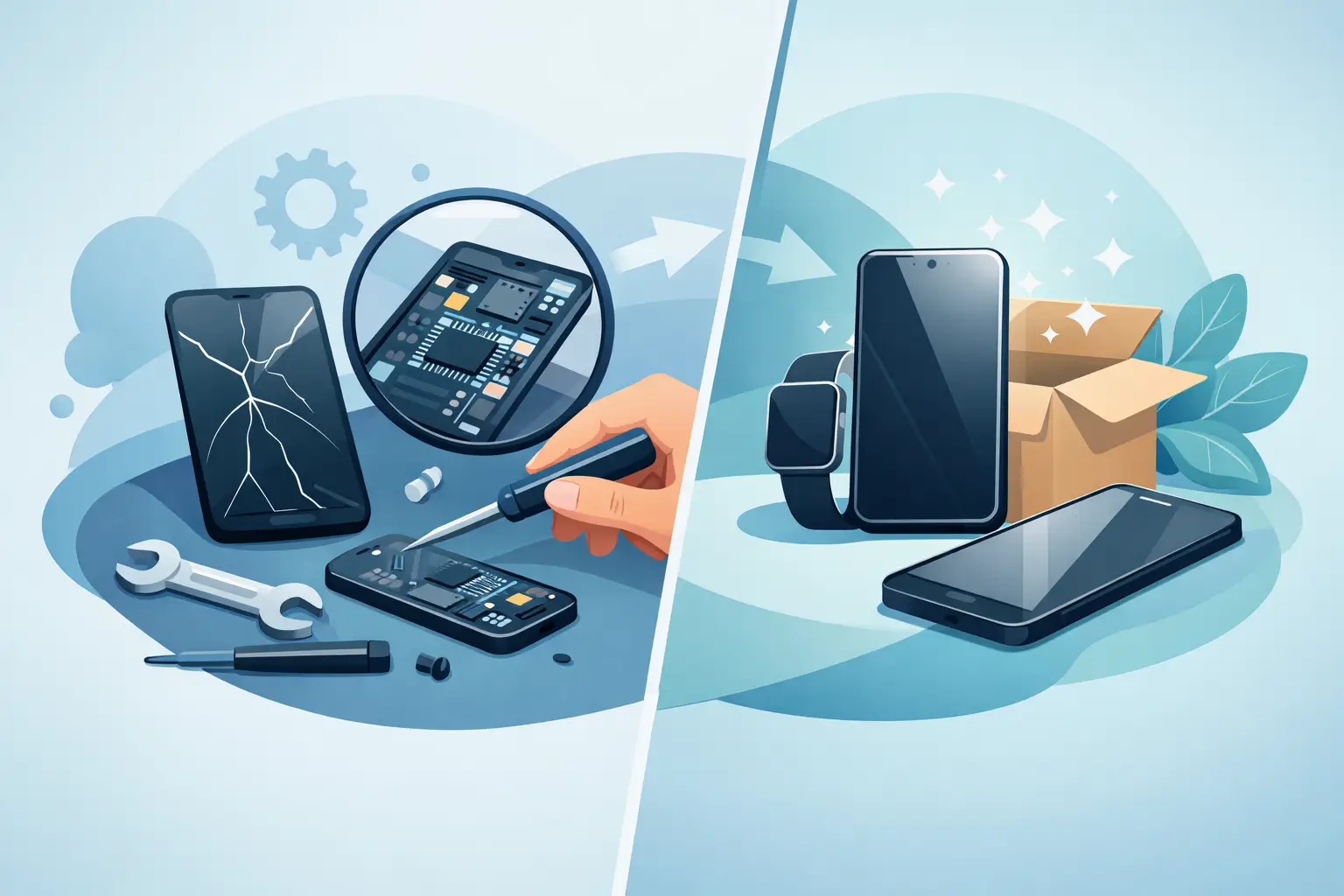
A cracked screen on the school run, a battery that drops from 40% to 3% on the train, or a charging port that only works if you hold the cable at a strange angle – this is usually the moment people ask the same question: should you repair the phone or replace the device? In most cases, the right answer comes down to cost, age, fault type and how urgently you need your tech back in working order.
For a lot of people, replacement feels like the obvious option because it sounds final and clean. But that is not always the most sensible or cost-effective choice. A professional repair can often restore a device quickly, for far less than the price of buying new, especially when the fault is limited to one part such as the screen, battery or charging port.
When to repair the phone or replace the device
The best place to start is with the fault itself. Some issues are straightforward and economical to fix. Others can point to wider damage or make less financial sense on an older device.
If your phone still does what you need it to do and the problem is limited to one component, repair is often the smarter route. A cracked display, worn battery, faulty speaker, camera issue or charging problem can usually be resolved without replacing the whole handset. If the phone is otherwise reliable, you are paying to restore function rather than starting again with a much bigger purchase.
Replacement becomes more likely when several things have gone wrong at once. For example, if a device has a smashed screen, poor battery health, frame damage and intermittent motherboard faults, the total repair cost may start to approach the value of the handset. At that point, it is worth stepping back and looking at the bigger picture.
Start with the numbers, not the frustration
When a device stops working properly, people often decide while they are annoyed. That is understandable, but it can be expensive. Before you replace anything, compare the repair cost with the realistic cost of a new or equivalent device.
A new handset is not just the price on the box. You may also need a charger, case, screen protector, data transfer time and the effort of setting everything back up. If you are upgrading by contract, the monthly cost matters too. A repair can look even better when you compare it with the full replacement cost rather than the headline price alone.
As a rough guide, repair tends to make sense when the fault is isolated and the quote is significantly lower than replacing the device with something of similar quality. That is especially true for premium phones, tablets and laptops, where a single part failure does not mean the whole device is at the end of its life.
The age of the device matters, but not in a simple way
People often assume an older device is never worth fixing. That is not always true. A two, three or even four-year-old phone can still be perfectly suitable for everyday use if performance is stable and software support remains available.
What matters more is whether the device still suits your needs. If you are happy with the camera, speed, storage and battery life once repaired, then age alone should not push you into replacing it. On the other hand, if the device already feels slow, struggles with updates or no longer lasts the day even after a battery replacement is considered, replacement may be the better investment.
Faults that are usually worth repairing
Some faults are common, predictable and usually cost-effective to sort. Screen damage is the most obvious one. If the phone still works well apart from the broken display, a screen replacement is often the clearest case for repair.
Battery replacements are another strong example. If your phone has become unreliable because it drains quickly, overheats or shuts down unexpectedly, fitting a fresh battery can make it feel usable again without the cost of buying new.
Charging port repairs also sit in this category. Many people assume a phone that will not charge is finished, when in reality the port may just be worn, blocked or damaged. The same goes for certain camera faults, speaker issues, microphone problems and button failures.
These are the kinds of repairs that experienced technicians deal with every day. If diagnosed properly, they can often be completed quickly and with a clear quote before work begins.
Faults that may point towards replacement
Some problems are less straightforward. Severe liquid damage can affect multiple parts over time, even if the device appears to recover at first. Logic board faults can also be more complex, particularly when the device has suffered impact damage, previous poor-quality repair work or power issues.
This does not automatically mean the device is beyond repair. It does mean the decision should be based on proper diagnosis rather than guesswork. A trustworthy repairer will tell you when a repair is sensible, when it is uncertain, and when replacing the device is likely to be the better option.
That honesty matters. You do not want to put money into one repair only to find another hidden issue appears a week later. This is one reason many customers prefer a local repairer with a no-fix-no-fee approach and clear communication from the start.
Repair the phone or replace the device for speed and convenience
Time matters just as much as money for many customers. If your phone is your alarm, wallet, sat nav, camera and work tool, being without it for days is a real problem.
That is where repair often has an edge. A same-day or while-you-wait repair can get you back up and running with far less disruption than sourcing a new device, setting it up, recovering passwords, restoring apps and moving data across. For students, parents, commuters and small business users, that convenience can be the deciding factor.
Replacement can still be the faster option if the device is completely dead and repair parts are not viable, but it is not always the shortcut people imagine. New devices take time to sort properly, and many people only realise that after they have committed.
Think about data before you decide
For many customers, the real value of a device is not the handset itself. It is the photos, messages, notes, apps and accounts on it. If your current device still powers on and the issue is physical rather than internal storage failure, repair may be the safest path to keeping access to your data with minimal disruption.
Replacing a phone can be straightforward if everything is backed up and your passwords are organised. If not, it can quickly become stressful. This is especially true when two-factor authentication codes, banking apps and work logins are tied to the damaged device.
If the fault involves water damage or the phone no longer turns on, diagnosis becomes even more important. In some cases, the priority is data recovery rather than full repair. That is another reason to get an expert opinion before making a rushed choice.
The quality of the repair matters
Not every repair is equal. A cheap fix that fails quickly is not a saving. What matters is whether the work is carried out properly, with quality parts, transparent pricing and a warranty that gives you confidence after collection.
This is where a trusted local repairer makes a real difference. You should know what fault has been identified, what part is being replaced, how long the job is expected to take and what happens if the issue cannot be fixed. Mobitech Sheffield builds its service around those basics because customers need answers they can rely on, not vague promises.
When the repair process is clear, it becomes much easier to make the right call. Sometimes that call is repair. Sometimes it is replacement. The important thing is getting a recommendation based on the actual condition of the device, not a sales script.
A practical way to make the decision
If you are unsure, ask yourself four things. Is the fault limited to one or two parts? Does the device still meet your needs when working properly? Is the repair cost comfortably lower than replacement? And can the repair be completed quickly enough to avoid major disruption?
If the answer to most of those is yes, repair is usually the sensible route. If the device has multiple faults, poor performance, limited software life left and a high repair estimate, replacement may be the better long-term choice.
The key is not to assume either option before the device is assessed. A proper diagnosis often turns a stressful problem into a straightforward decision.
If your phone, tablet or laptop has stopped working as it should, the best next step is simple: get a clear quote, get an honest diagnosis, and make the decision based on facts rather than frustration.
